
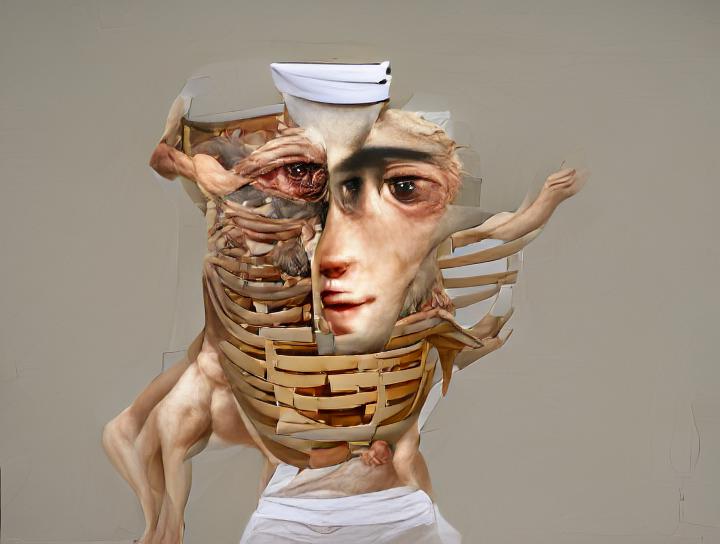
A few days ago, I was watching an analysis of the adult cartoon Rick and Morty (R&M). In the show, the lead character Rick explores many universes. We’re told that they’re infinite — but as far as we see, the universes he can experience always follow these two rules:
- They’re constrained by whatever makes a cartoon
- They must ultimately be conceivable to Rick
So they’re not really infinite, not in the sense that we understand it. The universe that we live in would be incomprehensible to him, just as his cartoon universe seems incomprehensible to us.
Because if the R&M multiverse is truly infinite, it would include ours… and, if our is infinite, it would include his.
When I realised this, my mind fractured and I briefly comprehended the existence of a real universe where R&M exists. Beyond the theoretical possibility of it, I was aware of the practical reality of such another universe; I felt it existing, and understood what that meant.
—
I can’t hold on to those insights for very long, only a second or two. When they happen, I gain a total understanding of something, a kind of empathy for that reality… but in the next moment, what I’m left with is a simplified understanding of that full picture. Often, I’m left wondering just what it was that I’d just experienced.
And that’s ok. Our minds can’t hold that amount of data; not for long, and not without breaking. That’s why I described it as my mind briefly fracturing – everything I knew had to be sacrificed for a moment, so that I could understand this all-encompassing concept. It’s not radically different from the effects of some drugs, where, at their peak, you might be capable of traversing entirely different planes of thinking, but as you come back to Earth, most of those realisations have to be left behind.
I have glimpsed true infinity in this way, and it was remarkable — but living in the time-based reality we inhabit meant that, again, I could only understand it for the briefest of flashes before my normal cognition had to resume, and the things I knew before were slot back into their familiar places.
—
One of my favourite fleeting epiphanies came when I was thinking about the ship of Theseus, many years ago. If you’re not familiar, it’s a popular thought experiment which goes like this:
There once was a great wooden ship, which we’ll call the Ship of Theseus. Built by hand using wood and iron, it held strong for many years, but eventually it came time to renovate its many parts. First, the masts were replaced, having buckled under the weight of many storms. Later, the planks that made the upper walkway were entirely swapped out for new ones, having been worn down by the stomps of booted feet. Eventually, every part of the ship was removed and replaced with some new part, identical in both form and function, but nonetheless different to what came before.
The question is then: Is it the same ship?
With this in my mind, I considered the often-stated fact that our bodies fully replace its cells every 7 years. I pondered further: If I woke up tomorrow and my hair was different, would it still be my hair? I think it would be, since when I have a haircut, the new hair that grows is still mine. And every day that I wake up, my hair looks different anyway! So, though it’s not the hair that was there before, it’s still part of who I am. Unfamiliar, perhaps, but still me.
And what if the next day, I awake to find my eyes a slightly different colour? My vision is still the same, I can read and recognise faces from the exact same distance, and again, they grew from me – but now my eyes are slightly different to how I feel they should be. Does this change me so much that I am no longer who I was? Can I no longer recognise myself? Can others no longer recognise me? No, I think that I’m still the same person, and while the outside doesn’t align perfectly with my own self-image, I myself have not changed.
What if I wake the next day, and every part of me has been replaced with something just a little bit different, but still me: my skin an almost imperceptible shade lighter, as though my ceiling light had grown brighter by a fraction of a degree; my wrinkles, still the same in number and severity, but appearing in different places, representing an ever-so-slightly different history of my facial expressions; my smell, still unmistakingly familiar to those who know me, but somewhat different now to me.
Am I still the same person? My thoughts and feelings have not changed, and the new differences are so minor that they would not be noticed by anyone who wasn’t cataloguing my component parts with obsessive accuracy. No, I am still me, I am still the person I was yesterday, the only difference is that my body no longer matches my mind as precisely as I feel it should.
And then I wondered: What if the same conditions applied the next day that I awoke – but this time, my physical sex was different?
It was in this moment that I understood, for the very first time, how it might feel to be trans. A flash of insight, a new layer of possible realities, a new level of empathy through which I can explore others.
This little thought experiment, having guided my mind outside of my physical body, had put me in a position where I could consider the physicality of my existence as something distinct from my own sense of self; my body now framed as “other”, my identity entirely internal, my material existence arbitrary. Never before had I considered such a separation; and, returning my mind to my body, I experienced how alien it might feel to resume a physical existence inside of a body that doesn’t align with what the mind expects.
I’m glad we can have these little chats, I mention to myself.